Support
Have a question? We are here to help.
Recent HIV Exposure
I am worried I have been exposed to HIV in the last few days, what should I do?
You should go to your doctor, HIV clinic or emergency department as soon as possible within 72 hours, as you may be able to access a course of medication called “PEP” (Post-Exposure Prophylaxis) to prevent you from becoming HIV positive.
What is the “window period”?
After exposure to HIV, it can be 6 to 12 weeks before your body develops the antibodies detected by this test. This time is called the “window period”. If you take an HIV self test during the window period, you may incorrectly get a negative result. If you believe you have recently been exposed to HIV, you are recommended to test again after the window period has passed.
Product FAQs
Summary of the Test
The FYNDO HIV Self Test is a single-use screening test for HIV infection.
It is comprised of a test strip inside a plastic cartridge. The test is performed by placing a small drop of blood onto the test strip and then applying drops of test fluid (diluent). When the test is completed, one or two lines will appear on the paper strip after 15 minutes to indicate the test result. The Control Line will only become visible if the test has been performed correctly. The Test Line will only become visible if the applied blood sample contains antibodies to HIV.
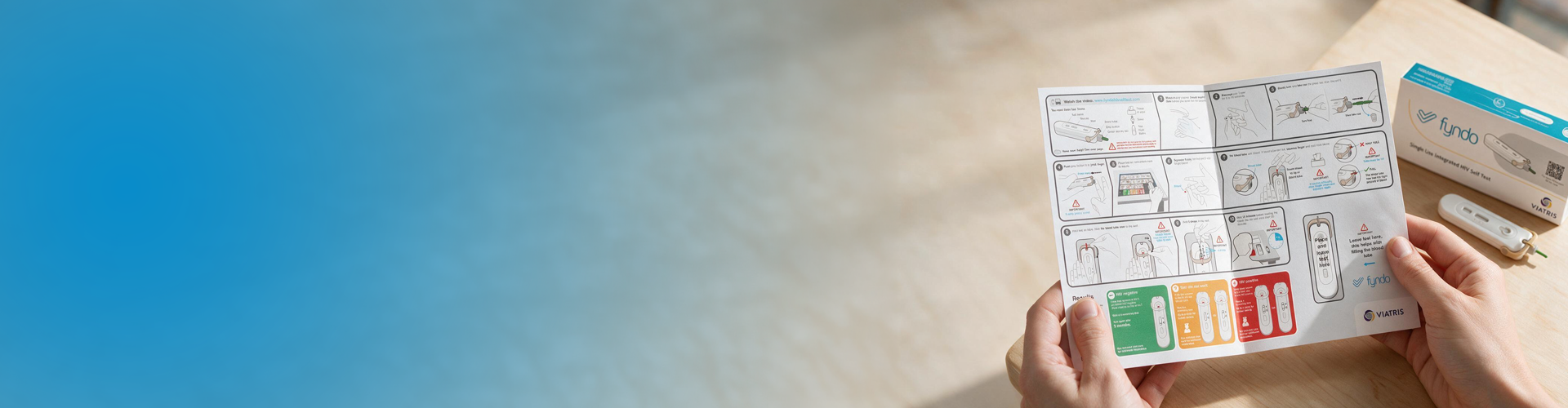
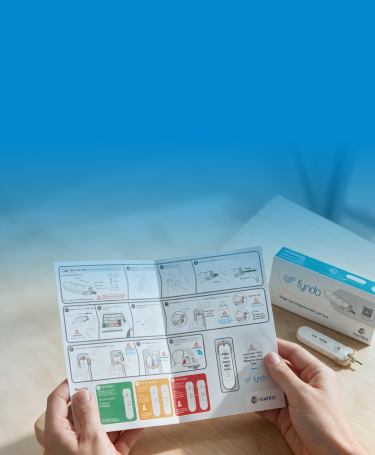
Box contents: Fyndo HIV Self Test (in foil packet with desiccant), Instructions for Use (IFU), Bottle of Test Fluid (Diluent), Disposal Bag, Care Card.
How does the FYNDO HIV Self Test detect HIV?
There are 2 types of Human Immunodeficiency Virus (HIV): HIV-1 and HIV-2. If you are infected with either HIV-1 or HIV-2 your immune system will generate antibodies against either virus type.
The FYNDO HIV Self Test is designed to detect these antibodies in human blood to determine infection by either virus type.
How many times can the device be used?
The FYNDO HIV Self Test is a single-use screening test. You can use it only once and it must be disposed of after use.
How to dispose of the test after use?
Place the test and all box contents into the disposal bag provided. The bag can then be sealed and thrown away with household rubbish.
Can the test be used by people taking antiretroviral treatment (ART)?
Antiretroviral treatment is medication which is used to treat HIV patients. The FYNDO HIV Self Test is not suitable for people taking antiretroviral treatment.
How accurate is the FYNDO HIV Self Test?
The FYNDO HIV Self Test has been shown in laboratory testing to correctly identify 99.6% of HIV reactive (positive) and non-reactive (negative) samples.
Procedure FAQs
Finger Prick
Filling the Blood Tube
Completing the Test
Can I get an infection from pricking my finger?
The test has an integrated safety lancet for pricking the finger and creating a blood sample; the lancet is sterile. The green sterility tab ensures that the lancet remains clean and sterile before use.
Having trouble removing the green sterility tab?
First turn the green sterility tab at least 90 degrees, then pull it out.
Scared it will hurt?
Don’t worry, it feels like a rubber band snap against your finger or a small and very short pinch on the finger. You will not see the needle before or after it has pricked your finger.
Pushed the grey button but can’t see blood?
Is the button out?
Try again, push hard. Note: It only pricks once!
Is the button in?
Squeeze your finger firmly, if you still don’t have blood - stop, you will need a new test.
Filling the Blood Tube
Don’t know where to put the blood?
The blood tube is straw coloured. After pricking the finger, fill the blood in the blood tube, it measures the correct amount of blood. Skin touching the tube won’t affect the result. Do not put the blood in the grey button hole. Do not put the blood directly in the well.
Can’t fill the blood tube?
- If blood smears, wipe your finger, then squeeze your finger firmly again.
- Point your finger down.
- Gently touch blood to the tip of the tube.
- If you don’t have enough blood, wipe your finger, then squeeze your finger firmly again. Make sure to squeeze from the base of the finger, behind the prick site. Don’t squeeze the finger from the sides. Slide up the finger towards the prick site to get a drop of blood.
- If you still don’t have enough blood to fill the tube completely, the test result won’t be accurate. Stop, and get a new test.
How do you know when the blood tube is full?
Blood should fill the tube from end to end. The tube collects exactly the right amount of blood needed for the test. The tube will stop filling automatically when it is full.
Completing the Test
What if the blood does not move from the tube to the well?
Make sure the tube is full. Make sure the tube is completely flipped over to the well: it will click into place and the blood will move from the tube to the well. If the blood still won’t move to the well, stop and get a new test.
Not sure how to add 4 drops from the bottle?
The 4 drops must go into the well on top of the blood. Don’t shake the bottle. Point the bottle down, then squeeze to add 4 drops into the well.
Not sure how to read the result?
Make sure you wait 15 minutes before reading the result. Don’t wait longer than 20 minutes. Lines that have appeared next to the “T” or “C” symbols on the test cassette will tell you your result. The Instructions for Use leaflet includes a red, orange and green box that will match your result. Put your test against each box in turn to find your match and to help with interpretation of your result. You will also find information on reading your result in the “About Your Result” section of the Instructions for Use leaflet.
Result FAQs
What happens if my test result is NEGATIVE?
It is important to know if it has been more than 3 months since your last risk event. If it has, and you have performed the test correctly, then you are likely to be HIV negative.
If it has been less than 3 months since your risk event, you will need to test again in 3 months. If you are unsure, seek doctor's advice.
Refer to the enclosed Care Card in the pack for more information.
What happens if my test result is POSITIVE?
Don’t panic. The FYNDO HIV Self Test is a screening test and a reactive or a positive test result does not necessarily mean that you have HIV. If the test result is positive, you need to go for follow-up testing at a healthcare facility. Refer to the enclosed Care Card in the pack for more information.
If you are diagnosed as HIV positive, you will be connected to counselling services and may be given antiretroviral (ARV) treatment. Only your doctor or healthcare professional can recommend what treatment is right for you.
Early diagnosis of HIV means treatment can start sooner. HIV is a manageable condition and people living with HIV are able to live long, active, and healthy lives.
What happens if my test doesn’t work?
The test will not give a result if it is not performed correctly. You will need to repeat the test using a new test device or speak to your doctor or healthcare professional for follow-up testing.
How will I know if my test has worked?
If you see a line next to the ‘C’ symbol on the test cassette it means you have performed the test correctly.
If you see a line next to the ‘C’ symbol on the test cassette but you are not sure if you have performed the test correctly, please refer to the following trouble shooting questions.
Trouble shooting - reasons why the test may not have worked?
- Is the product expiry date current?
- Was the foil pouch and test fluid bottle packaging in good condition, i.e., no tears, openings, etc?
- Was the test used immediately upon opening?
- Was the blood tube full?
- Did the blood move from the blood tube to the test strip?
- Were 4 drops of test fluid (diluent) added?
- Did you wait 15 minutes before reading the result?
- Did you read the result before 20 minutes had elapsed?
If the answer is no to any of these questions, the test may not have worked correctly; in which case you should dispose of the test and perform another test using a new device or speak to your doctor or healthcare professional.